
Choosing the best dog muzzle means finding one that keeps your dog safe and comfortable while serving your specific needs. With so many options available, from cheap imports to professional-grade equipment, understanding what makes a muzzle effective helps you make the right choice for your dog.
At Company of Animals, we’ve been designing muzzles for over 40 years. Our founder, Dr Roger Mugford, is a world-renowned animal psychologist who transformed how people understand and work with dogs. His pioneering work in reward-based training methods led to the development of equipment that works with dogs’ natural behaviour rather than against it.
Today, Company of Animals is led by Dr Emily Mugford. As a veterinary surgeon with over 20 years’ experience in small animal practice, Emily evaluates every product through the lens of animal welfare – ensuring muzzles are designed to support dogs’ physical and emotional wellbeing, not simply restrain them.
The guidance in this article draws on expertise from Fiona Whelan, Head Behaviourist at our Pet Centre in Chertsey, Surrey. With over 20 years’ experience working with dogs of all temperaments, Fiona understands which dog muzzles work in real-world situations and why quality matters.
This guide compares the best dog muzzles for different needs, explains what to look for when choosing, and addresses common misconceptions about muzzle use.
What Makes a Dog Muzzle “The Best”?
The best muzzle for your dog depends on several factors: what you need it for, your dog’s face shape, and how often you’ll use it. However, all quality muzzles share certain essential features.
Allows Natural Behaviour
A good muzzle must allow your dog to pant freely, drink water, and receive treats. Panting is how dogs regulate body temperature – any muzzle that restricts this puts your dog at risk. The ability to take treats is essential for positive reinforcement training and helps create good associations with wearing the muzzle.
Durable Construction
Cheap muzzles often use flimsy materials that determined dogs can bite through or that break under stress. Quality muzzles use materials like TPR (thermoplastic rubber) that provide strength without excessive weight. This matters for safety – a muzzle that fails when you need it defeats the purpose.
Proper Fit
The best muzzle in the world won’t work if it doesn’t fit your dog properly. Look for muzzles with adjustable straps and, ideally, the ability to reshape for a custom fit. A muzzle should be secure without being tight, with room for full mouth opening.
Comfort for Extended Wear
If your dog will wear a muzzle regularly, comfort features like padding, lightweight materials, and ergonomic design make a significant difference to their experience.
Why Quality Matters: Not All Muzzles Are Equal
When choosing a muzzle, quality directly affects safety. As Fiona Whelan, our Head Behaviourist, explains: “If you go into your local pet shop and see a muzzle for £20, then go online and see what looks like the same thing for £6, there’s probably a good reason one is £6 and one is £20. You really need to look at the quality.”
Cheaper muzzles often have several problems. Silicone copies of basket muzzle designs are flexible and soft – a determined dog can simply bite through them, offering no real protection. Poor-quality straps break or slip. Rough edges and poor construction cause discomfort and rubbing. What appears to be a bargain can end up being useless or even dangerous.
Thermoplastic rubber (TPR) basket muzzles, like the Baskerville range, provide advanced bite protection because the material is strong enough to resist pressure while remaining comfortable. They’re also reshapable in hot water, allowing you to customise the fit for your individual dog.
Important: Muzzles Will NOT Stop Barking
One of the most common misconceptions about muzzles is that they can be used to stop barking. This is incorrect and potentially dangerous.
A correctly fitted basket muzzle allows full mouth movement, which means dogs can still bark normally. Any muzzle tight enough to prevent barking would be dangerously restrictive – it would prevent panting, which dogs need to regulate body temperature, and could cause serious welfare issues.
If you’re looking for help with barking, the solution is training that addresses the underlying cause – whether that’s boredom, anxiety, territorial behaviour, or something else. A muzzle is not the answer for barking and should never be used for this purpose.
Comparing the Best Basket Muzzles
Basket muzzles are recommended by veterinarians and behaviourists because they allow natural behaviour while providing effective safety. The Baskerville range offers four basket muzzles, each designed for different needs. All muzzles within the Baskerville range are made from extra strong TPR (thermoplastic rubber), meaning the muzzle can be reshaped easily by submerging in hot water to fit your dogs unique shape.
Baskerville Ultra: Best for Durability and Active Dogs
The Ultra is built for dogs who need a robust, hard-wearing muzzle for regular use. Its extra-strong TPR construction handles daily wear and active lifestyles while the ergonomic design ensures comfort.
Best for: Active dogs, regular daily use, owners who need maximum durability.
Face shape: Suits dogs with longer or broader noses – Labradors, German Shepherds, Golden Retrievers, and similar breeds.
Key features: Extra-strong TPR material, ergonomic fit, allows panting, drinking, and treating, reshapable with hot water for custom fit, adjustable straps.
Baskerville Classic: Best for Scavenging Prevention
The Classic is the go-to choice for dogs who eat things they shouldn’t on walks. Its removable anti-scavenge guard creates a barrier that prevents dogs from picking up food waste, faeces, rocks, or other items – even when pressing their nose to the ground.
Best for: Scavenging dogs, coprophagia (poo eating), preventing wound licking during recovery.
Face shape: Particularly well-suited to dogs with narrower or longer noses – Collies, Greyhounds, Spaniels, and similar breeds.
Key features: Removable anti-scavenge guard, padded noseband for comfort, allows panting, drinking, and treating, reshapable with hot water, adjustable straps.
Baskerville Wide Fit: Best for Broad-Nosed Breeds
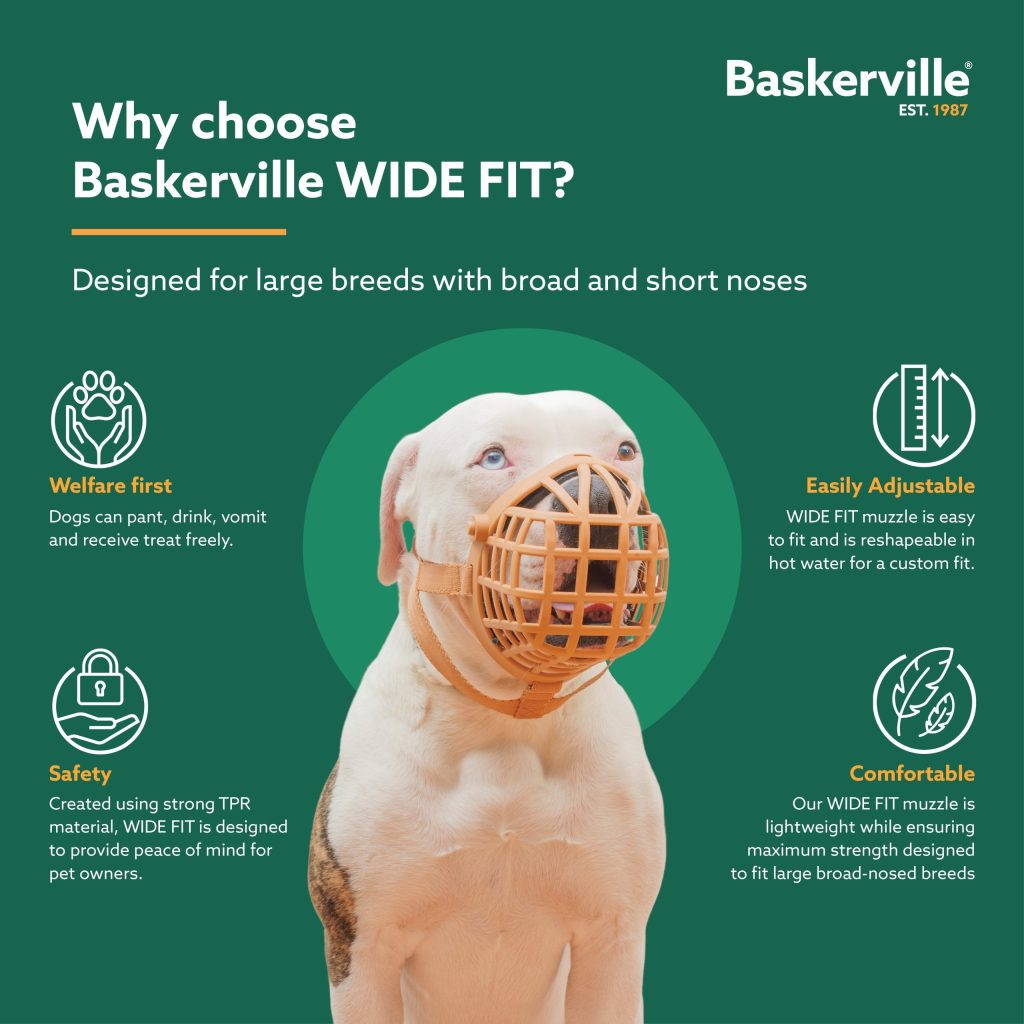
The Wide Fit is designed specifically for dogs with shorter, broader faces. Standard muzzles often pinch or don’t fit properly on these face shapes – the Wide Fit provides a more accommodating design that works with rather than against their anatomy.
Best for: Brachycephalic breeds and dogs with broad faces who struggle with standard muzzle shapes.
Face shape: Bulldogs, Pugs, Boxers, Staffies, Rottweilers, and other broad-nosed breeds.
Key features: Wider basket design, padded noseband, full panting room (especially important for breeds with compromised airways), reshapable with hot water, adjustable straps.
Baskerville INVISA: Best for Comfort and Reducing Stigma
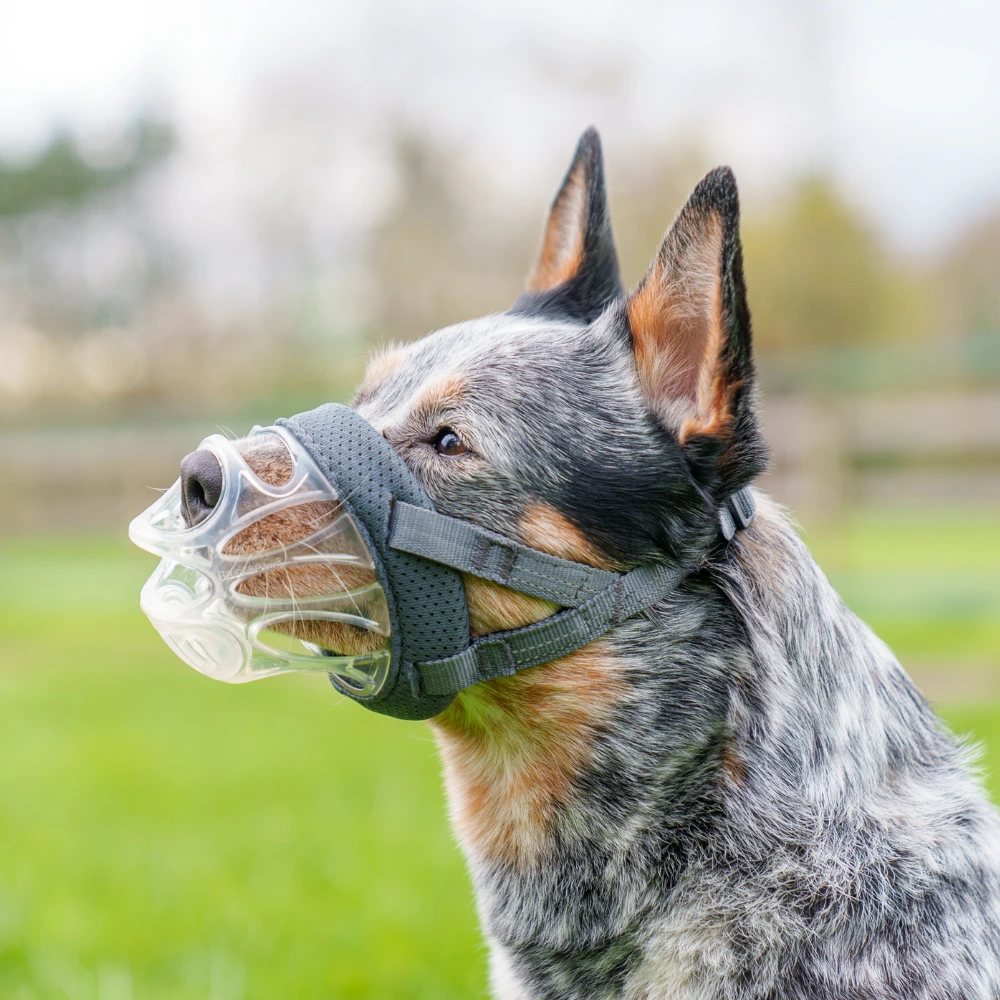
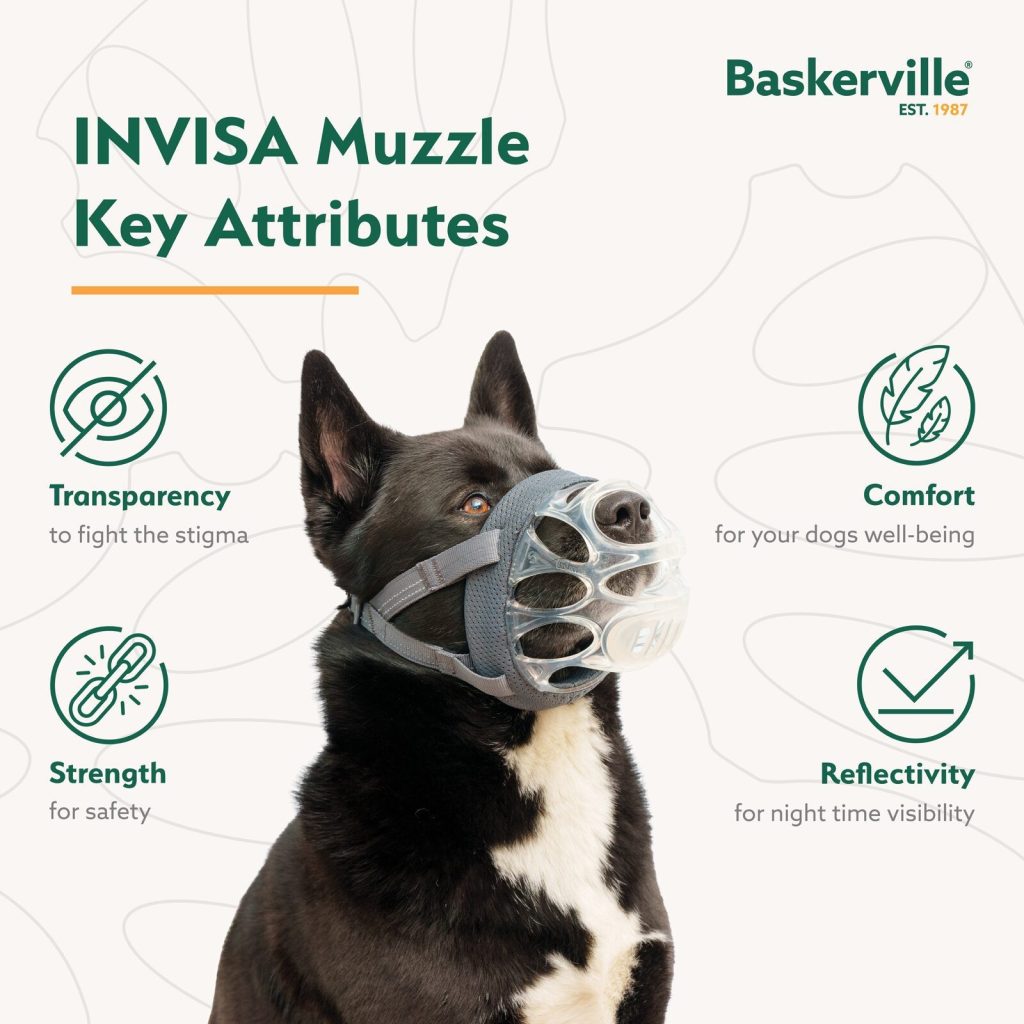
The INVISA features a transparent basket design that allows people to see your dog’s face rather than just the muzzle. This helps reduce the negative reactions muzzled dogs sometimes receive and can make encounters with other people less tense.
It’s also the lightest and most comfortable muzzle in the range, making it ideal for extended wear during long walks or when maximum comfort is the priority.
Best for: Long walks, owners concerned about muzzle stigma, dogs who need maximum comfort, scavenging prevention (with guard).
Face shape: Works well for many face shapes in correct sizing – medium to longer noses.
Key features: Transparent design, 360-degree padding for superior comfort, lightest in range (50g Size 1 to 220g Size 6), removable anti-scavenge guard, V-shaped strap system (no head strap needed), reflective stitching for nighttime visibility, reshapable with hot water.
Quick Comparison: Which Muzzle for Which Need?
By Primary Purpose
General safety and bite prevention: Any Baskerville muzzle – all provide advanced bite protection with TPR construction.
Scavenging and coprophagia: Baskerville Classic (first choice) or INVISA – both feature anti-scavenge guards.
Wound licking prevention: Baskerville Classic or INVISA – the anti-scavenge guard prevents access to wounds.
Long walks and extended wear: Baskerville INVISA – lightest weight with 360-degree padding.
Reducing muzzle stigma: Baskerville INVISA – transparent design shows your dog’s face.
Active dogs and durability: Baskerville Ultra – extra-strong construction for demanding use.
Brachycephalic breeds: Baskerville Wide Fit – designed specifically for broader face shapes.
By Face Shape
Long or narrow noses (Collies, Greyhounds, Spaniels): Baskerville Classic or Ultra.
Broad or short noses (Bulldogs, Staffies, Boxers): Baskerville Wide Fit.
Medium faces (many crossbreeds, medium-sized dogs): Any Baskerville muzzle in correct size – INVISA offers transparency benefit.
What About Fabric Muzzles?
Fabric muzzles, sometimes called soft muzzles or sleeve muzzles, hold the mouth closed. While they might appear gentler, they create serious welfare concerns.
Because fabric muzzles restrict mouth opening, dogs cannot pant properly. This prevents them from regulating body temperature and can lead to dangerous overheating. They also cannot drink, take treats, or vomit safely if needed.
For anything beyond momentary veterinary use lasting seconds rather than minutes, fabric muzzles are not appropriate. This is why we only produce basket muzzles at Baskerville – they’re the only design that allows natural behaviour while providing effective safety.
How to Size Your Muzzle Correctly
Even the best muzzle won’t work if it doesn’t fit properly. Here’s how to measure:
Length (most important): Measure from the tip of your dog’s nose to the base of the nose, just below the eyes. The tip of your dog’s nose should not touch the end of the muzzle when fitted.
Circumference: Measure around the widest part of your dog’s muzzle, usually just below the eyes. Ideally, measure with your dog’s mouth open to ensure adequate panting room.
If your dog falls between sizes, always size up. A slightly roomier muzzle is safer than one that’s too tight.
All Baskerville muzzles can be reshaped with hot water for a custom fit. Warm the basket in hot tap water for one minute, shape to your dog’s face, then cool in cold water to lock the shape.
Frequently Asked Questions
Are dog muzzles safe for everyday use?
Yes, basket muzzles are safe for everyday use as long as they’re correctly fitted and allow dogs to pant, drink, and receive treats. Dogs should never be left unsupervised while wearing a muzzle, and in hot weather you should monitor closely and provide regular water breaks.
What type of dog muzzle is best for barking?
No muzzle is appropriate for stopping barking. A correctly fitted basket muzzle allows full mouth movement, including barking. Any muzzle tight enough to prevent barking would be dangerously restrictive. If barking is a concern, address it through training that tackles the underlying cause – not equipment.
How do I choose the right size dog muzzle?
Measure your dog’s nose length (tip to base below eyes) and circumference (around the widest part, ideally with mouth open). Compare to the sizing guide for your chosen muzzle. The length measurement is most important. If between sizes, size up. All Baskerville muzzles can be reshaped with hot water for a custom fit.
Can a dog drink water whilst wearing a muzzle?
Yes, with a basket muzzle. Dogs should be able to drink, take treats, and even vomit if necessary when wearing a correctly fitted basket muzzle. This is one of the key differences between basket muzzles and fabric alternatives, which hold the mouth closed and prevent drinking.
Which is the most comfortable muzzle for long walks?
The Baskerville INVISA, due to its 360-degree padding for improved comfort and its lightweight design. It’s the lightest muzzle in the Baskerville range, which helps reduce fatigue during extended wear.
Can a muzzle prevent biting completely?
Baskerville muzzles are made from super-strong Thermoplastic Rubber (TPR) material which provides advanced bite protection. This is significantly more effective than cheap silicone copies, which are flexible and soft and can be bitten through. Whilst no muzzle is 100% bite-proof, a correctly fitted, quality basket muzzle substantially reduces bite risk.
Choosing the Right Muzzle for Your Dog
The best dog muzzle is one that fits your dog properly, serves your specific needs, and is made from quality materials that will last. Cheap alternatives may look similar but often fail when you need them most.
The Baskerville range offers a muzzle for every dog and every situation: the Ultra for durability, the Classic for scavenging prevention, the Wide Fit for broader faces, and the INVISA for maximum comfort and reduced stigma. All share the same commitment to allowing natural behaviour while providing effective safety.
For expert guidance on choosing the right muzzle or help with muzzle training, our Pet Centre in Chertsey offers behavioural consultations by veterinary referral. Speak to your vet if you’d like to access our team of experienced behaviourists.