
Training your dog shapes every aspect of your life together. It builds safety, confidence, and communication – the foundations of a genuinely rewarding partnership. This guide brings together the complete Coachi range of dog training tools, explaining what each one does, when to use it, and how to combine them for maximum effectiveness.
At Company of Animals, we’ve spent over 40 years at the forefront of dog behaviour and training. Founded by Dr Roger Mugford, a world-renowned animal psychologist whose pioneering methods reshaped how people work with dogs, we continue to champion reward-based training that makes training accessible and effective for everyday owners. Under the directorship of Dr Emily Mugford, a veterinary surgeon with extensive experience in the pet industry, every product remains grounded in behavioural science and practical application. Our Pet Centre in Chertsey, Surrey has helped thousands of dogs and their owners since 1979, and the Coachi range reflects decades of expertise in understanding how dogs learn best.
Our behaviour team includes CFBA (Canine & Feline Behaviour Association) qualified specialists, and our Pet Centre in Chertsey, Surrey has helped thousands of dogs and their owners since 1979.
Why Dog Training Tools Matter
Training relies on three elements: clarity, consistency, and motivation. Tools aren’t shortcuts – they’re aids that help you deliver all three more effectively.
Tools improve clarity
Clear communication makes training faster. Your dog needs to know exactly which behavior earned the reward, and that feedback must come immediately.
A clicker produces a distinct sound at the precise moment your dog gets it right. That single click tells your dog “yes, that’s the behavior I want, and a reward will follow.” The timing is critical – dogs learn through immediate association, and the clicker bridges the gap between behavior and reward delivery.
A whistle removes the variables that come with your voice. Whether you’re tired, excited, or calling from distance, a whistle produces the same consistent sound every time. Your dog learns to recognize that specific tone, making recall reliable even in challenging environments
Tools support consistency
Consistency builds reliable behavior. Dogs learn through repetition, but that repetition only works if your signals remain stable.
Training lines provide controlled freedom during recall practice. Your dog experiences distance from you while the line prevents self-rewarding behaviors like chasing wildlife or approaching other dogs without permission. This controlled setup allows consistent repetition – your dog learns that recall always results in rewards, while ignoring the cue never leads to reinforcement from the environment.
Treats and reward toys maintain motivation across multiple sessions. Food rewards show your dog that responding to cues is worthwhile, while toys provide alternative motivation for dogs who aren’t strongly food-driven or who need variety to stay engaged.

Tools build confidence
Tools support the consistency and clear communication that build confidence. When your dog reliably understands what you’re asking and consistently receives rewards for correct responses, they become more willing to try new behaviors. This applies whether you’re working with a bold puppy or a nervous rescue dog – the right equipment simply makes it easier to deliver the consistency and clarity that create confident learners.
Why Coachi is trusted
Every Coachi product has been designed and refined by behavior specialists at the Company of Animals. This isn’t theoretical product development – these tools are used daily in training classes with dogs of all ages, breeds, and temperaments.
Practical details matter. Treat pouches sit comfortably at the waist with wide-mouth access. Whistles are lightweight and produce frequencies within dogs’ optimal hearing range. Training lines use materials that resist tangling and glide smoothly during recall practice. These refinements come from years of hands-on use and direct feedback from trainers and owners.
The Coachi range also pairs products with clear educational guidance, helping first-time owners feel confident in their approach and ensuring tools are used effectively rather than misapplied.
The Coachi Range – What You Need and Why
Recall Training with Lines
A recall training line allows your dog freedom to explore while you maintain control during the learning phase. The line isn’t just a safety net – it’s an active training tool that ensures your dog learns reliable responses without ever practicing failure.
The Coachi training line is designed specifically for recall work. Lightweight materials prevent drag, the length provides genuine distance experience, and the construction resists tangling during outdoor training.
Choosing the right length
Puppies and smaller breeds work well with a 5-meter line. This provides meaningful recall distance while remaining manageable in backyards or quiet spaces.
Adult dogs and larger breed puppies benefit from a 10-meter line for parks or open fields. The extended length replicates real off-leash scenarios, preparing your dog for the distances they’ll encounter during actual walks.
How to use a training line correctly
The line must always attach to a harness, never a collar. If your dog reaches the end suddenly, a harness distributes force safely across the chest rather than pulling on the sensitive neck and throat.
Hold the line during initial training so you can guide your dog if needed. Once your dog begins responding reliably to your recall cue, you can let the line trail loosely behind them. Continuous pressure teaches dogs to pull against restraint, so a trailing line (used once responses are established) only engages when your dog moves beyond the desired distance, providing natural feedback without creating opposition.
When your dog doesn’t respond to your recall cue, use the line to guide them back to you – not to drag or pull harshly. Give your recall command once, then gently guide with the line while continuing to encourage verbally. Always reward when your dog returns, even if you needed to use the line for guidance. This teaches that returning always results in positive outcomes, regardless of how the return happens.
Common mistakes with training lines
Attaching the line to a collar creates unnecessary neck pressure and potential injury risk. Always use a harness.
Allowing your dog to ignore recall cues defeats the training purpose. If your dog doesn’t respond, use the line to guide them back. The line prevents self-rewarding behaviors (chasing, wandering) while teaching that ignoring cues doesn’t lead to fun outcomes.
Repeating your recall command multiple times teaches your dog to ignore the first cue. Give the command once, then use the line if needed. Each repetition without response is practice at ignoring you.
Training in environments that are too challenging sets your dog up to fail. Start in quiet spaces with minimal distractions, building reliability before gradually introducing more complex environments. If your dog becomes completely focused on a distraction, move further away and rebuild attention before attempting recall.
Not rewarding successful recalls means the line becomes merely a physical restraint rather than part of a positive learning system. The line provides safety during learning, but consistent rewards build the actual behavior.
Real-world application
Progress systematically through three types of environments:
Category A locations (low distraction): Quiet fields with few other dogs, minimal wildlife, good visibility. Start all recall training here.
Category B locations (moderate distraction): Areas with some wildlife, varied scents, moderate dog activity. Progress here once Category A responses are reliable.
Category C locations (high distraction): Busy parks, areas with significant wildlife, high dog traffic. Work here only after success in A and B locations.
The Coachi training line maintains safety throughout this progression, allowing you to reinforce recall regardless of environmental challenges while your dog builds the habit of returning consistently.
Recall Commands with a Whistle
For many years, whistles have been used successfully to train and control dogs, particularly when working at distance from the handler. Shepherds deliver specific instructions quickly and effectively over long distances – imagine trying to make yourself heard on the Yorkshire Moors in a storm with only your voice. Gundog trainers have long recognized whistle benefits when working in thick cover, open fields, or farmland.
But whistle training isn’t just for professional handlers. Many pet owners experience significant benefits when training their dogs to respond to whistle cues.
Key benefits of whistle training
High-frequency sounds are more attention-grabbing than human voices. Dogs’ hearing sensitivity peaks around 3,500-4,500 Hz, and whistles produce sounds within this optimal range.
Whistles deliver commands over much greater distances than voice. The acoustic properties allow the sound to carry clearly even in wind, around ambient noise, or across fields where verbal commands become unclear.
Whistle commands are easier to standardize between handlers. If multiple family members walk your dog, everyone can produce the same whistle tone using the same pattern, creating consistency that’s difficult to achieve with voice commands that vary in pitch, volume, and emotional tone.
Whistles keep commands emotion-free. A whistle never sounds angry, frustrated, or anxious. This neutral quality means your dog responds to the cue itself rather than trying to interpret your emotional state, which can affect their willingness to return.
The Coachi dog whistle and Coachi training whistle are lightweight, durable, and designed for daily outdoor use. For owners who prefer minimal equipment, the Coachi Whizzclick combines whistle and clicker in one compact tool.
Getting started with whistle training
Before attempting to teach your dog whistle commands, practice using the whistle yourself. Your whistle patterns must be sufficiently different so your dog doesn’t become confused about what you’re asking.
Traditional whistle patterns work well:
Multiple short pips (typically two or three) = recall command
One long continuous blast = sit or stop at distance
Choose patterns you’re comfortable producing consistently. Only when you can effectively deliver clear, distinct whistle tones should you introduce them to your dog.
Teaching the recall whistle
Recall training needs reinforcement throughout a dog’s life and should start as early as possible. A reliable recall isn’t just desirable – it’s a necessity that may one day save your dog’s life.
For most dogs, the walk is the most exciting part of their day. Anything they can do to extend that time is in their best interest. If returning to you means lead on and end of fun, even the most devoted dog may decide that ignoring you is more rewarding than returning. Dogs rarely respond for “love” alone – like humans, they require payment for motivation.
For the average well-fed dog, a few standard biscuits won’t provide sufficient motivation. Treats need to be extra special – small pieces of cooked chicken, cheese, or sausage work well. Teaching your dog fun games during walks keeps them focused and responsive to you.
The training sequence:
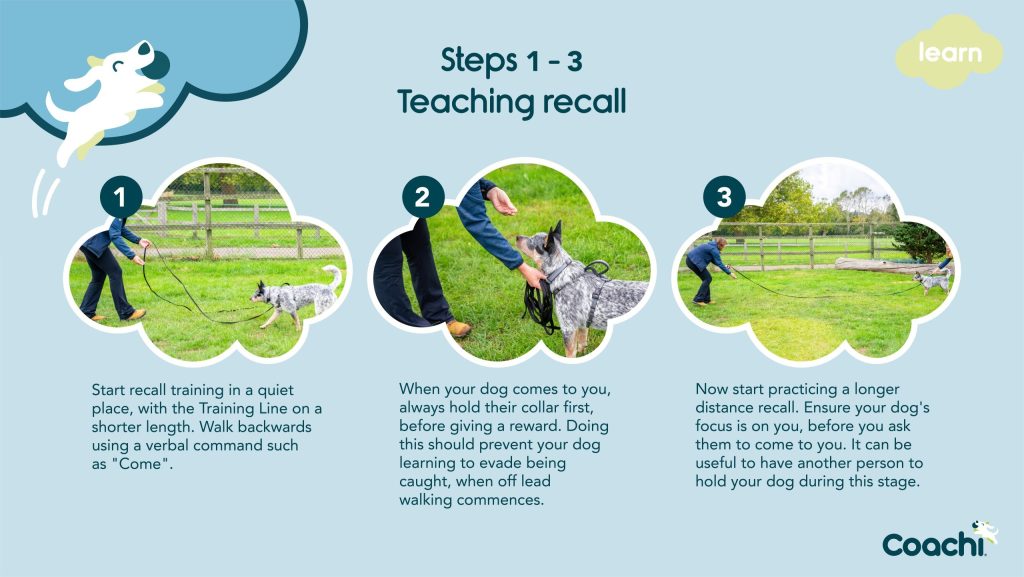
Start in a quiet area without distractions. Attach your training line to your dog’s harness (never to a choke chain or collar alone for safety).
Allow your dog to wander away from you a short distance. Call their name in an enthusiastic voice and give your chosen whistle command while opening your arms wide.
Back away from your dog, encouraging them towards you as you go. If they’re reluctant to come, gently use the long line to guide them in – don’t drag or pull harshly.
Once they reach you, reward immediately with a food treat or a game with a favorite toy. The reward must be genuinely valuable to your dog.
As your dog understands the pattern, start dropping your verbal command and use only your whistle and open-arm signal. This teaches your dog that the whistle itself is the recall cue, not the combination of voice and whistle.
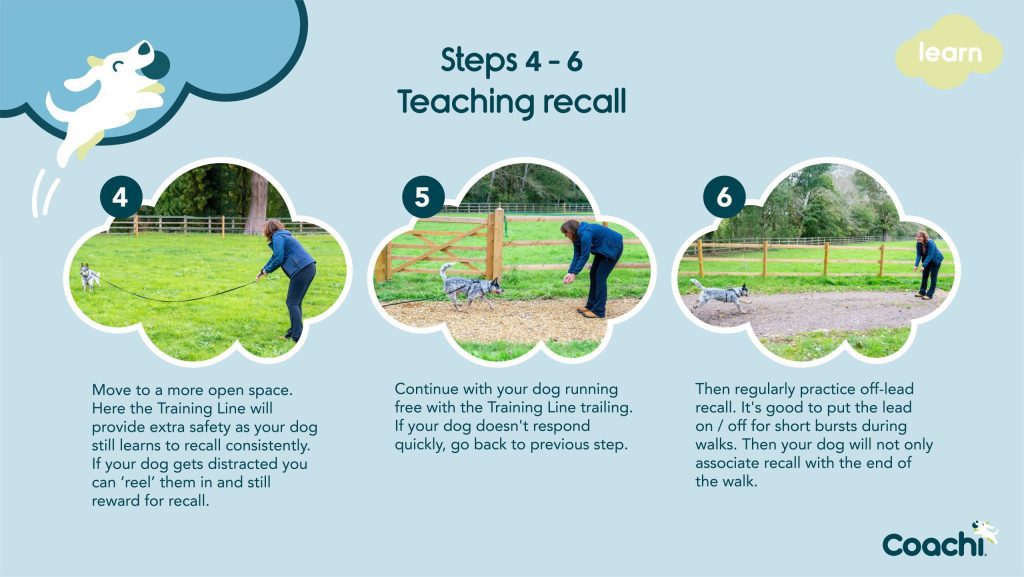
Gradually extend the distance from which you recall your dog, always ensuring success by having the training line as backup.
Practice in new areas, gradually increasing distraction levels. Work through Category A locations (low distraction) before progressing to Category B (moderate) and Category C (high distraction).
Once your dog responds consistently, start dropping the line so it trails behind them. Give your whistle and open-arms signal. If they respond, reward immediately. If they ignore you, calmly walk towards them until you can pick up the line, repeat your whistle command once, and immediately guide them back and reward. If your dog frequently ignores you, return to holding the line at all times for several days before trying to release it again.
Once your dog reliably responds without you needing to pick up the line, you can transition to off-lead freedom – though many owners find keeping the line attached (but trailing) for the first few off-lead sessions provides extra security.
Common mistakes with whistle training
Not conditioning the whistle before expecting recall responses is the primary error. Your dog must learn that the whistle predicts valuable rewards before it can function as a cue. The training sequence above builds this association systematically.
Repeating the whistle command when your dog doesn’t respond teaches them the sound is optional. Give the whistle cue once. If there’s no response, move closer to your dog, use your training line to guide them back, then heavily reinforce the return. Each repeated whistle without compliance is practice at ignoring the cue.
Using the whistle when your dog cannot respond sets both of you up for failure. Don’t whistle-cue recall when your dog is fixated on another dog, mid-chase, or overwhelmed by a major distraction. Build reliability at close range in quiet environments first, then gradually increase both distance and distraction level.
Failing to reward every whistle response means the sound loses its predictive value. Particularly during the first 6-12 months of whistle training, every single whistle cue that results in your dog returning should produce something highly valuable. Inconsistent reinforcement teaches your dog that responding is optional.
Using standard treats that don’t motivate your dog undermines the entire training system. The reward must genuinely compete with environmental distractions. For recall training, save your best rewards exclusively for whistle responses.
Teaching the sit at distance
A distant sit is useful and potentially lifesaving. A sitting dog is under control and more likely to be calm and responsive to further commands.
Start by teaching the sit with a hand lure. Hold a treat just above your dog’s nose and slowly take it up and back. As their head comes up, their bottom should go down (if they jump up, you’re holding the treat too high).
As their bottom touches the floor, give your chosen whistle command – typically one long continuous blast. Praise in the sit position and reward with the treat.
Release your dog from the position with a release command (such as “OK”) as you encourage them forward. This teaches that sit is a position to hold, not just a brief touch-down before they stand again.
Gradually phase out the treat in your hand but continue giving the hand movement, which becomes a useful visual signal to reinforce your whistle command. Understanding the difference between cues (signals that request behavior) and rewards (what your dog receives for complying) helps keep your training clear and effective.
Practice in different situations until your dog performs reliably every time.
Distance work:
Stand only a short distance from your dog initially. Give your hand signal and whistle command for sit.
If they respond, return to your dog and reward them enthusiastically. Return to your dog to deliver the reward – this is critical. If you call your dog to you for the reward, you’re reinforcing recall, not the sit-at-distance. Or if the dog comes to you voluntarily. You can also throw a reward to them; the important thing is that the reward comes at the point they stopped, not for returning.
If your dog ignores the command, take a step towards them without repeating the cue. Your proximity often prompts the response. Once they respond, go to them and reward.
Gradually increase the distance at which you can sit your dog. Patience is essential – distance work takes time to develop reliably.
Start adding distractions gradually until you’ve proofed your command in all the places and contexts where you’ll use it.
Marking Behavior with a Clicker
A clicker is one of the most effective positive reinforcement tools available. The sound marks the exact behavior that earned the reward, creating clarity that verbal praise can’t match.
The Coachi clicker is designed for easy one-handed use. For versatility, the Coachi Whizzclick combines clicker and whistle, allowing you to mark behaviors and cue recalls without switching equipment.
Clickers work exceptionally well for recall training. When your dog responds to your recall cue and starts moving towards you, clicking at that precise moment – when they turn or begin moving in your direction – strengthens the response significantly. You’re marking the decision to return, not just the final arrival. This creates faster, more enthusiastic recalls because your dog understands exactly which part of the behaviour sequence earns reinforcement.
Many trainers click the moment the dog’s head turns towards them after the recall cue, then again as the dog arrives. This double-marking reinforces both the initial response and the completion, building speed and reliability simultaneously.
Loading the clicker
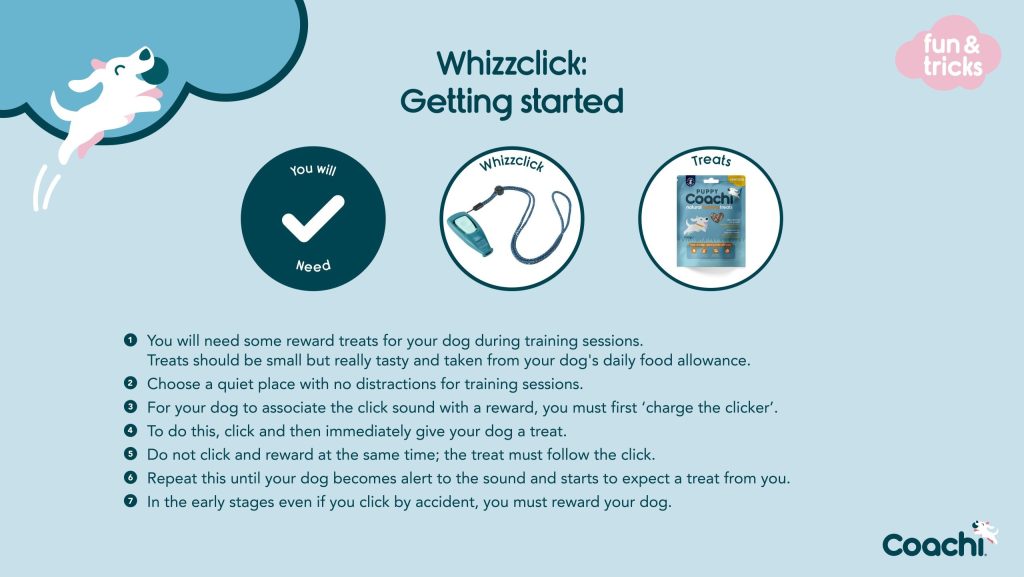
Before using a clicker in training, you must “load” it – teach your dog that the click predicts a reward. Click, then immediately deliver a treat. Repeat multiple times with no behavioral demands. When your dog looks expectantly at you after hearing the click sound, displaying anticipation for the treat, the association is established and the clicker is ready for training applications.
Best applications
Clickers are excellent for teaching foundation behaviors to puppies and adult dogs alike. The precision helps dogs understand quickly what earned the reward, whether you’re working on recall, loose-leash walking, or basic obedience.
Adult dogs respond well to clickers in any training scenario, particularly when learning new behaviors or refining precision in known behaviors. For dogs with previous recall problems, the clicker helps reset their understanding by providing crystal-clear feedback about correct responses.
Common mistakes
Not loading the clicker before starting training means the sound carries no meaning for your dog. Always establish the click-treat association through multiple repetitions before attempting to use the clicker for actual training.
Clicking multiple times for one behavior dilutes the marker’s precision. One click marks one behavior – though you can follow that single click with one treat or multiple treats as a ‘jackpot’ reward. Multiple clicks suggest multiple separate behaviors, confusing your dog about what exactly earned the reward. The click is the marker, the treats are the payment, and those are separate functions.
Not rewarding after every click breaks the fundamental contract. The click must always predict food delivery. If you click without following through with a treat, the clicker rapidly loses its predictive power and becomes meaningless.
Clicking too late means you’re marking the wrong behavior. If teaching recall and you click after your dog has already arrived and sat down, you’ve reinforced sitting rather than the act of coming when called. Timing requires practice – some trainers improve their coordination by having one person act as the “dog” performing various actions (sitting, standing, turning around) while the other person practices clicking at the exact moment the action occurs, then immediately reaching for a treat. This person-to-person practice builds muscle memory and timing skills before working with your actual dog.
Real-world example
Teaching recall with a clicker: Call your dog using your chosen recall cue (verbal or whistle). The moment your dog turns their head towards you, click immediately. Continue encouraging as they move towards you. When they arrive, slide one hand gently into their collar while delivering the treat with your other hand. This sequence marks the initial response decision (head turn), rewards the approach, and creates a positive association with collar contact.
Practice this multiple times in a quiet environment before progressing to areas with mild distractions. The precision of the click helps your dog understand that turning towards you when called – not just eventually wandering back – is what earns rewards.
Training with Treats and Pouches
Food rewards motivate learning and make training enjoyable. Timing matters critically, so pairing treats with a practical pouch for immediate access improves your training effectiveness.

Calming treats
Calming dog treats may support anxious or sensitive dogs during training in busy environments or new experiences. Coachi calming treats are made with a delicious blend of turkey, sweet potato, and pea, combined with natural calming elements like L-tryptophan, chamomile, and lavender to help ease your dog’s anxiety and promote relaxation.
When used as directed, calming treats are safe for daily use. Follow guidance, with a general benchmark of 1 treat per 5kg of body weight. These treats work best as part of a broader behavior modification approach rather than as standalone interventions and can be used at any time, even as a post-training reward.
Treat pouches
A dog treat pouch keeps rewards accessible at your waist, eliminating the delay that occurs when reaching into pockets. This immediate access ensures reinforcement timing remains within the critical one-second window where learning is most effective.
Look for pouches with secure waist attachment, wide-mouth access for quick grabbing, and compartments for different reward values. Many training sessions require mixing standard treats with high-value options for challenging behaviors or strong distractions.
Training Through Play with Toys
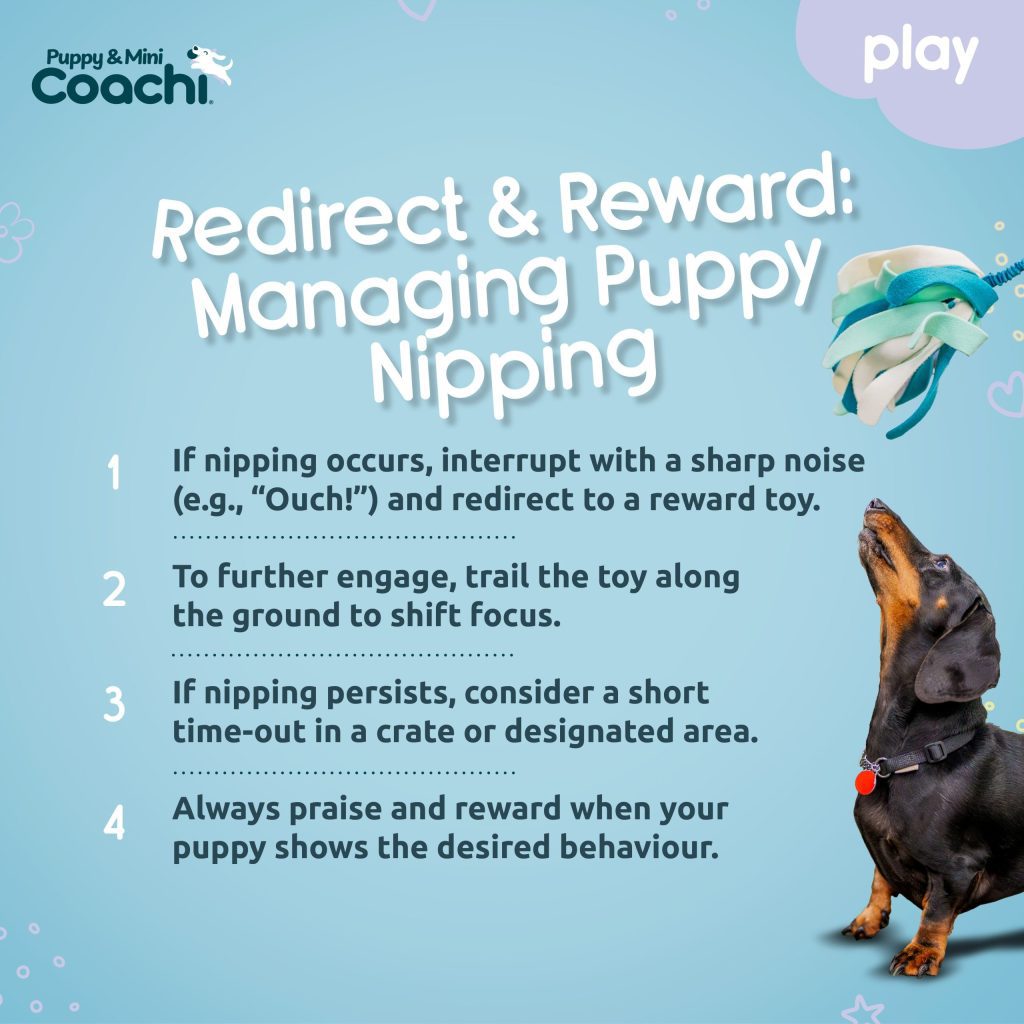
Puppy toys and training toys build confidence, focus, and engagement through play. Our dog training toys function as powerful rewards that keep learning dynamic and enjoyable.
Puppy-specific toys
The Coachi Puppy & Mini range provides lightweight, soft toys designed for small mouths and developing teeth. These toys accommodate teething puppies while building positive associations with interactive play.
Soft materials prevent discomfort during tug games or retrieval practice, encouraging puppies to engage willingly rather than avoiding play that feels uncomfortable.
Toys for all dogs
Training toys for adult dogs offer more robust construction for stronger jaws while maintaining the same reward function. Tug toys, balls, and interactive toys provide alternative motivation for dogs who aren’t strongly food-driven or who benefit from variety in their training rewards.
Common mistakes with training toys
Being too rough during play can overwhelm puppies or create overly aroused play styles. Keep tug games controlled with clear rules: take the toy on cue, release on cue, and play stops if arousal becomes too high.
Selecting toys that are too large for your puppy’s mouth prevents proper grip and makes play frustrating rather than rewarding. Always match toy size to your dog’s current mouth size and strength.
Allowing constant access to training toys reduces their value as rewards. Keep training toys special – they appear during training sessions and then get put away, maintaining their status as high-value items worth working for. Your dog can still have their regular everyday toys available; it’s specifically the training toys that should remain special and separate.
Real-world applications
Training toys work particularly well for:
Recall training – a favorite toy as the reward for coming when called can be more motivating than food for toy-driven dogs
Redirecting mouthing and chewing – giving puppies an appropriate outlet prevents unwanted chewing on furniture or hands
Building engagement during training – teaching reliable eye contact and focus through play
Motivating dogs who aren’t food-focused – if your dog shows minimal interest in treats, a quick play session can provide the motivation needed for effective training.
Retrieval Training with Dummies
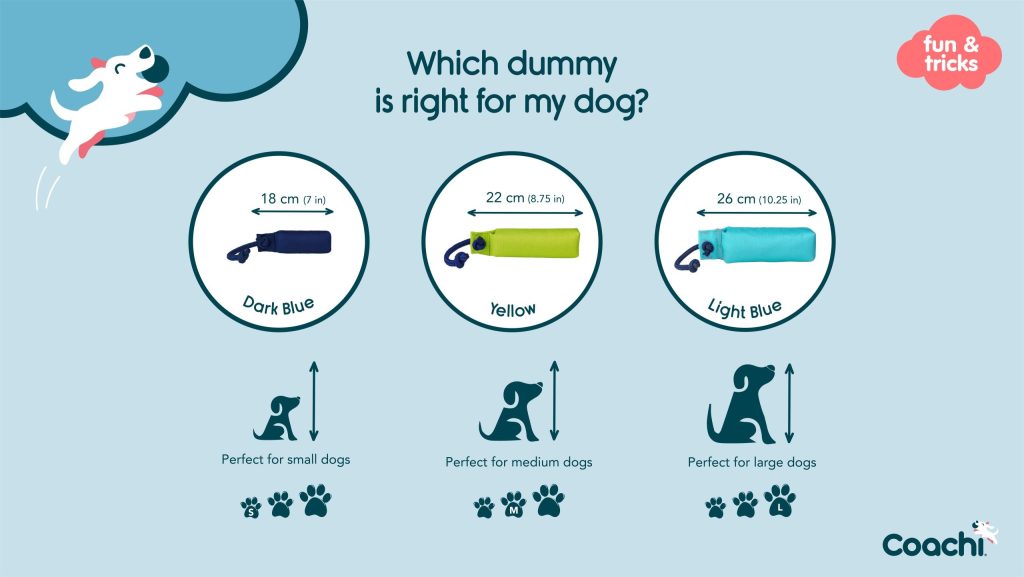
For dogs who love fetch or breeds with natural retrieving instincts, a training dummy develops structured retrieval skills rather than chaotic chasing.
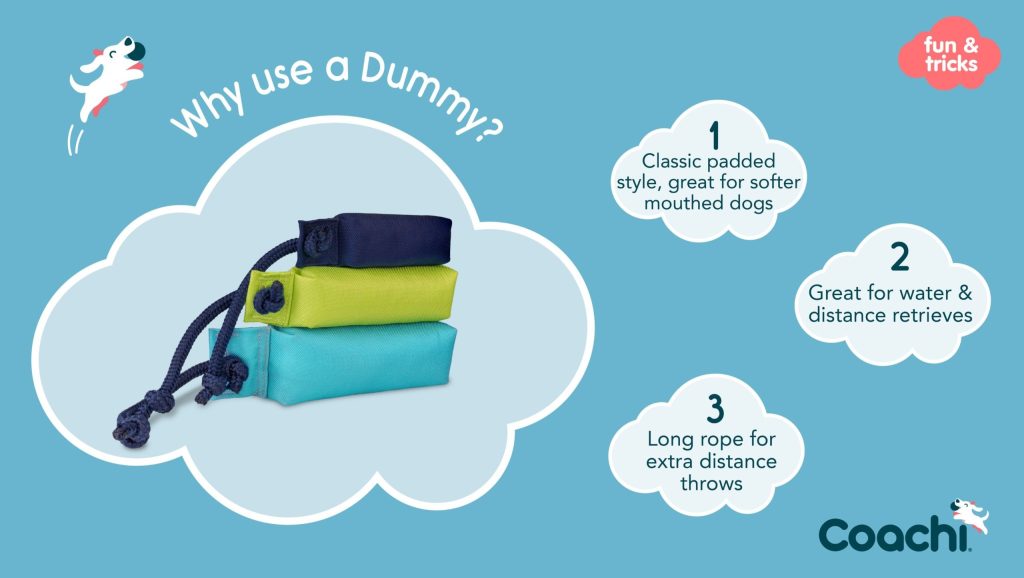
The Coachi training dummy is lightweight yet durable, designed for systematic retrieval training that builds impulse control and reliable return.
Key features
The attached rope extends throw distance significantly, allowing you to build retrieval range systematically. This is particularly useful for advanced training where you’re gradually increasing the distance your dog must cover to retrieve.
The dummy’s buoyancy makes it ideal for water work with dogs who love swimming. It floats high enough to remain visible and accessible, expanding your training environments beyond land-based practice. Water training requires caution regardless of location. Never allow your dog to swim where you cannot see the bottom or assess depth and current. Dogs tire quickly in water, and currents are often stronger than they appear. Monitor water consumption during play, as drinking excessive amounts of any water (rivers, lakes, ponds, or sea) can cause digestive upset. After swimming in sea water, rinse your dog’s mouth and coat with fresh water, as salt can irritate skin and cause dehydration if ingested in large amounts.
The weight and soft texture suit dogs with gentle mouths, including gun dog breeds and puppies learning to carry objects without damaging them. The dummy’s construction encourages proper mouth grip without promoting excessive biting or shaking.
Building reliable retrieval
This systematic approach builds reliable retrieval chains rather than partial compliance where your dog picks up the dummy but then runs circles around you or drops it halfway back.
Building Your Training Toolkit
Different training stages and dog types require different equipment combinations. Here’s how to match tools to your needs.
Starter kit for first-time owners
Core equipment: treat pouch, training treats, and training line (5m or 10m depending on your space and dog size). Many owners also find a clicker and/or whistle helpful for clarity and distance communication. This combination covers foundation training: recall, basic obedience, and establishing communication. Start here regardless of your dog’s age.
Puppy kit for small breeds
Essential equipment: soft puppy toys from the Coachi Puppy & Mini range, small training treats, clicker, 5-meter training line, treat pouch
Smaller dogs and puppies benefit from equipment scaled to their size. Lightweight lines prevent overwhelming force, soft toys accommodate developing teeth, and appropriately sized treats allow frequent rewards.
Advanced recall kit
Distance equipment: Whizzclick (whistle and clicker combined), 10-meter training line, high-value treats, Coachi reward toy as a jackpot reward
This combination supports reliable recall in challenging environments. The longer line allows realistic distance work, while the toy provides an alternative reward for toy-motivated dogs.
Care and Maintenance
Proper maintenance extends the life of your training equipment and ensures hygiene.
Clean whistles and clickers regularly with a damp cloth, particularly after outdoor use. Remove any debris that might affect sound quality or function.
Treat pouches can be wiped clean or, if the manufacturer’s guidance allows, washed in cool water. Check care instructions before machine washing to prevent damage to closures or structure.
Rinse training dummies after beach or lake use to remove sand, salt, or debris. Allow to dry completely before storage to prevent material degradation.
Training lines should be inspected regularly for fraying or wear and tear.
Common Training Challenges
My dog ignores the clicker
This usually means the clicker hasn’t been properly loaded or the association has weakened over time. Rebuild the click-treat connection without any behavioral demands. Click, treat immediately, repeat 10-15 times. When your dog shows anticipation after the click sound (looking at you expectantly or moving towards you), the association is strong enough for training use.
My dog doesn’t respond to the whistle
First, ensure your dog understands what the whistle means. Has it been paired with rewards consistently? If not, go back to foundation work: blow whistle, deliver high-value treat, repeat 20-30 times before using it as an actual recall cue.
Second, assess whether you’re using the whistle in situations where your dog can’t respond. Don’t whistle-cue recall when your dog is fixated on another dog or mid-chase. Build reliability at close range first, gradually increasing distance and distraction.
Third, ensure you’re rewarding every successful response. If the whistle doesn’t consistently predict something valuable, your dog learns to ignore it.
My puppy mouths the training line
Puppies often grab and chew training lines during early sessions. Don’t pull against them – this creates a tug game. Keep the line slack, ignore mouthing behavior rather than reacting to it, and redirect to appropriate toys once your puppy releases. If mouthing persists despite ignoring it, spray the line with a pet-safe bitter deterrent.
My dog gets over-excited with training toys
Arousal management is essential for toy-based training. First, teach a release cue using food rewards: offer a high-value treat when your dog naturally releases the toy to take it. As they release, immediately say your release word (such as “drop” or “give”), then give them the treat. Repeat this many times – your dog releases toy, you say the release word, reward follows. This builds the association between the word and the natural behavior. Once your dog reliably releases toys when you offer the food reward and say the release word, the word itself becomes the cue you can use to request the release. Your dog learns that self-control allows play to continue, while over-arousal ends the fun.
Train Smarter with Tools You Can Trust
Behind every Coachi product sits decades of behavioral expertise from Company of Animals, a team committed to making training accessible for everyday owners.
Training isn’t just about obedience – it’s about building a richer, safer life together. When your dog understands what you’re asking, feels motivated to respond, and experiences training as rewarding rather than confusing, the relationship deepens.
The Coachi range brings together tools refined through years of practical use at Company of Animals, where behavior consultations, training classes, and real-world experience inform product development. This practical feedback ensures every product supports clear communication and consistent progress.
Enriching pets’ lives – devoted to the physical and mental wellbeing of companion animals.
Whether you’re starting fresh with a new puppy or working through challenges with an older companion, the right equipment – combined with the positive reinforcement methods developed and refined at the Company Of Animals over four decades – makes training clearer, kinder, and more effective.
FAQs
What are the essential dog training tools every pet owner should have?
Start with a recall training line (5 or 10 meters depending on your dog’s size), clicker, whistle, treat pouch, training treats, and at least one reward toy. This combination covers recall, basic obedience, and positive reinforcement across different scenarios. You can add specialized tools like dummies or target sticks as your training progresses.
At what age should I start using training tools with my puppy?
From the day your puppy arrives home, typically around 8 weeks. Keep early sessions gentle and brief (5-10 minutes), using appropriately sized equipment from the Coachi Puppy & Mini range. Puppies can learn foundation behaviors like recall, sit, and loose-leash walking from the start, provided the approach remains positive and age-appropriate.
Are Coachi training tools suitable for small dogs?
Yes. The Coachi Puppy & Mini collection is specifically designed for small mouths and lighter builds. Toys are soft and lightweight, training lines are easier to handle without creating excessive force, and treats are sized for frequent use without overfeeding. All tools work effectively regardless of breed size when matched appropriately to the individual dog.
How does a clicker improve training results?
A clicker marks the exact moment your dog performs the correct behavior, creating clarity that speeds up learning. The sound occurs faster than you can deliver a treat or say “good,” so your dog understands precisely which action earned the reward. This precision is particularly valuable when teaching complex behaviors or working at distance, where timing can be difficult to maintain with verbal markers alone.
Can I use a whistle and clicker at the same time?
Yes. Many owners use a Whizzclick to combine both tools efficiently. Blow the whistle as your recall cue, then click the moment your dog turns towards you or starts moving back. This combination marks the exact behavior (turning or moving towards you) within the larger recall sequence, strengthening the response. Whistle cues the behavior, click marks correct execution, treat rewards completion.
How often should I use dog training treats?
Training treats can be used daily, provided you account for them in your dog’s overall food allowance. Coachi training treats are just 2 calories each, allowing frequent rewards without causing weight gain. Many trainers reduce meal portions by 20-30% on training days to maintain proper energy balance while keeping treats motivating. Use higher-value treats for difficult behaviors or challenging environments, and standard treats for known behaviors in low-distraction settings.
Are calming dog treats safe for daily use?
Yes, Coachi calming treats are safe for daily use when used according to our guidance. Calming treats help sensitive dogs settle in busy environments or during new experiences. Always follow dosage recommendations, with a general benchmark of 1 treat per 5kg body weight. These treats work best as part of a broader approach that includes proper training technique and gradual exposure to triggers, rather than as standalone solutions.
How many tools should I use in one session?
Use whatever tools support your training objectives for that session. A typical recall training session might include a training line, whistle, treat pouch, and training treats – four tools working together. The key is keeping sessions short (10-15 minutes) and focused rather than trying to work on too many different behaviors at once. Quality trumps quantity in training.
How can I make training more fun for my puppy?
Blend play with learning by alternating between treats and puppy training toys as rewards. Some puppies respond better to a quick tug game than to food, while others benefit from the variety. Keep sessions brief and upbeat, ending on success rather than continuing until your puppy loses focus. Use toys from the Coachi Puppy & Mini range that suit smaller mouths, making play comfortable and confidence-building rather than frustrating.
Where can I buy all Coachi training tools in one place?
Visit the Company of Animals website for the complete range, including training lines, whistles, clickers, pouches, dummies, treats, and training toys. Products are organized by training stage (Learn, Play, Fun & Tricks, Rewards) to help you find appropriate tools for your dog’s current level.
What is the role of the Company of Animals in product design?
Company of Animals in Chertsey, Surrey, provides training classes and behavior consultations where Coachi tools are used daily. This hands-on environment ensures products address genuine challenges rather than theoretical scenarios. Trainers and behavior consultants provide direct feedback on equipment performance, leading to continuous refinement based on practical use with dogs of all ages, breeds, and temperaments.
Who are Dr Roger Mugford and Dr Emily Mugford?
Dr Roger Mugford is a world-renowned animal psychologist and founder of Company of Animals. For over 40 years, he has pioneered reward-based training methods and developed tools that transformed how people understand and work with dogs. His approach emphasizes positive reinforcement and practical application rather than outdated dominance theories.
Dr Emily Mugford became CEO in 2024. She is a highly experienced veterinary surgeon with more than 20 years in small animal practice. Emily holds advanced qualifications in Emergency and Critical Care, and Small Animal Medicine, having achieved Advanced Practitioner status with the RCVS in these subjects. She knows firsthand the impact behavior can have on the bond we have with our pets. Under her leadership, Company of Animals continues the legacy of evidence-based, welfare-focused product development and training support.